What lies behind natural wine?
People. Choices.
A whole year in a bottle.
Bert knows the wine world as both an importer and a grower. His view begins with the people caring for the plants, bringing in the harvest and guiding the wine. This is what he sees behind a bottle.
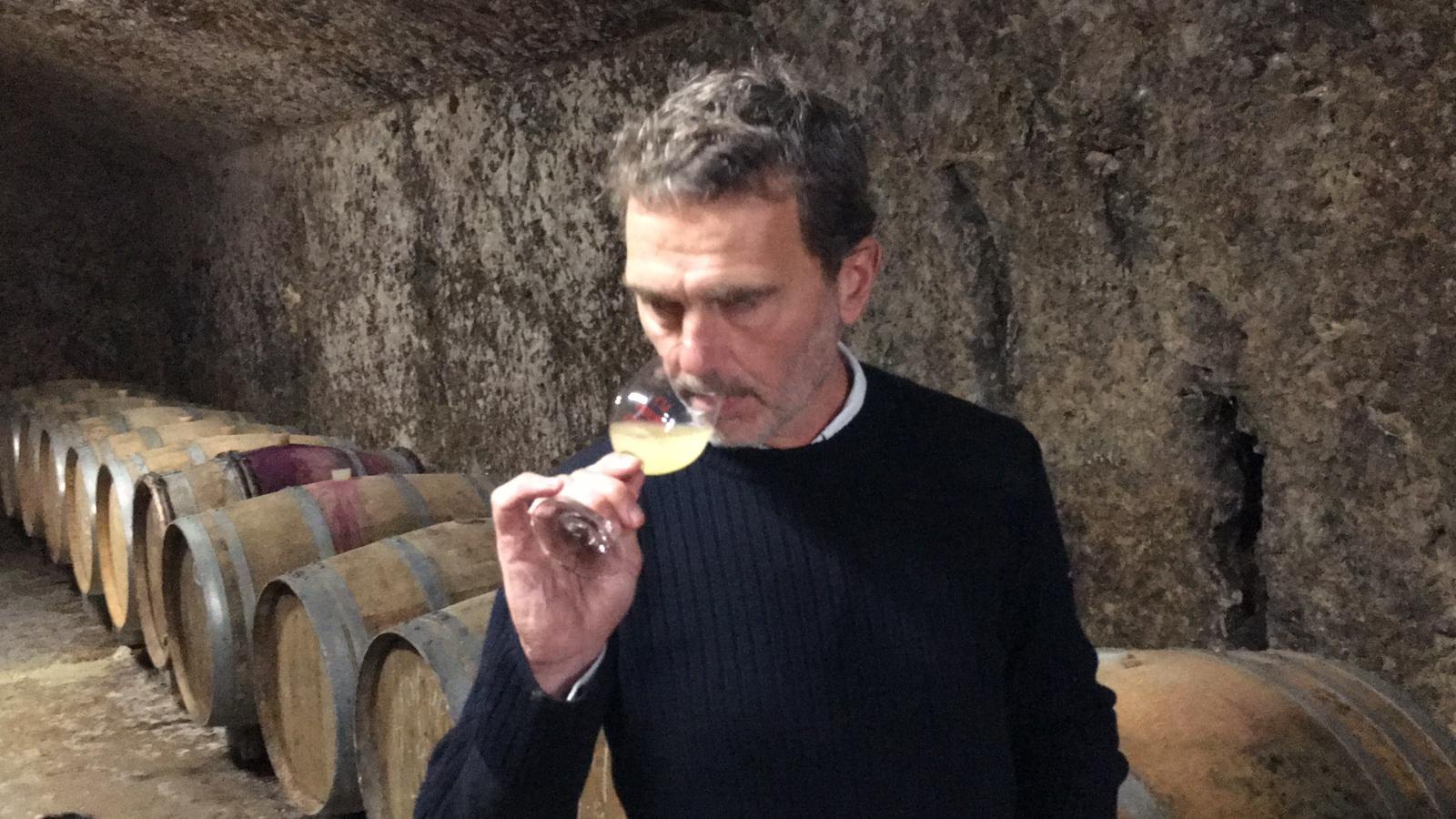
Every grower has a different beginning.
Some growers are born on an estate. They grow up among the vines, help as children and learn from the generations before them. Others begin in an entirely different profession. Until their love of wine, nature and the earth becomes strong enough to take their lives in another direction.
Bert knows both worlds. As an importer, he spent years visiting growers and their cellars. Those encounters nurtured his desire to make wine himself. In 2017, he took that step with our family. Since then, he has also understood the choices behind a bottle through his own vineyards.
Trust, with your hands in the earth.
Winemaking is demanding work, with few certainties. What remains at the end of a year depends on much more than hard work alone. The weather, the harvest, the strength of the plants: a grower takes responsibility for a world that can only partly be controlled.
It calls for trust. And attention. How do you care for the plants? How do you work with the growth between the rows? What space do you make for diversity in and around the vineyard? Every grower finds a path of their own, in a place of their own.
There is no fixed recipe.
Each vintage brings its own possibilities. Small berries, high acidity, plenty of grapes or very few. Picking time matters, as do the people doing the work. Bringing in experienced pickers at the right moment takes organisation and money.
The choices continue in the cellar. Wood or concrete? What pace, what temperature, how much time? Experience helps, but each year calls for fresh observation, tasting and response. Sometimes it means improvising with what is available.
For Bert, there is something of an artwork in that. A grower brings experience, feeling and an idea together with what the year makes possible. The result carries something of all those decisions.
Freedom calls for attention.
How much freedom do you give a vineyard? And how much freedom does a wine have during fermentation and maturation? The natural wine world has strong convictions about these questions. Bert wants to understand how a grower works and why they make particular choices.
As you guide children, growers guide their plants and wines. Being present, observing, sometimes acting and sometimes being patient. For Bert, a wine’s individuality emerges through that relationship. You taste the place and the year, and may also recognise something of the grower’s energy and character.
More attention. A fair market.
We see how much interest natural wine attracts. More bottles, more wine bars, more people becoming curious. We love that. At the same time, we ask what this growth means for the people working the land.
For us, a wider offering does not automatically mean more organic or biodynamic land, or a more secure life for growers. In our conversations, we also see competitive pressure and the struggle to keep a domaine going. That deserves attention, especially as so many people enjoy natural wine.
The value of a bottle.
Behind a bottle are months of work, a year of decisions and often many years of experience. There is also the risk of a disappointing harvest. Looking only at the price tag leaves much of that story unseen.
At Bruut, it matters that growers are paid well. That the value of their work reaches them too. We want a market in which they can keep caring for their land, plants and families. A fair price is part of that.
That is why we tell the stories of the people behind our wines. Their work, doubts, joy and individuality. For Bert, a good bottle begins with that connection. Around the table, we love passing the story on.
Explore the craft in pictures: handwork and biodynamics ↗
ALSO GOOD TO KNOW
It begins with grapes
At Bruut, the focus is on organically or biodynamically grown grapes, fermentation with indigenous yeasts and minimal intervention in the cellar. Methods differ by grower.
Orange is a way of making wine
White grapes can ferment with their skins. Skin contact adds colour and structure, producing orange wine. Nicole from Domaine la Taupe is an example in our selection.
No added sulphites is not the same as sulphite-free
Sulphites can be present through fermentation even when none are added. We therefore describe what the maker has done for each wine and use the allergen information on the label.